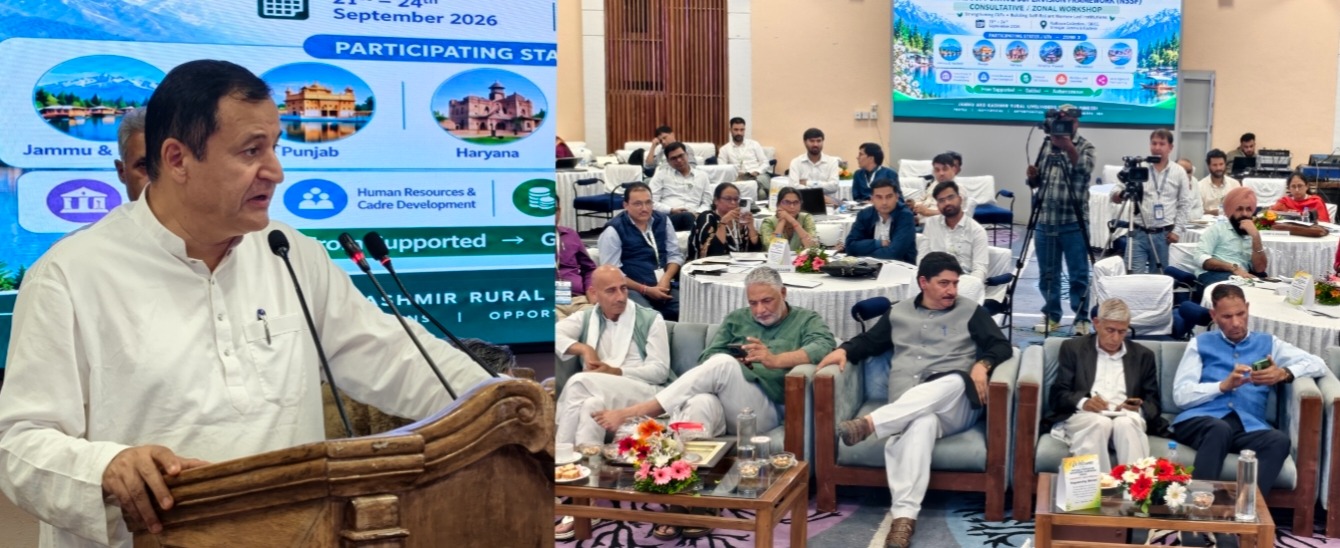
SRINAGAR, SEPTEMBER 21: Minister for Agriculture Production, Rural Development and Panchayati Raj, Cooperative and Election Department, Javid Ahmad Dar, today inaugurated the zonal workshop on the National Supportive Supervision Framework (NSSF) under the Deendayal Antyodaya Yojana–National Rural Livelihoods Mission (DAY-NRLM).
The four day workshop brought together representatives and stakeholders from Jammu & Kashmir, Ladakh, Himachal Pradesh, Uttarakhand, Punjab and Haryana. The initiative is aimed at providing a common platform for reviewing the progress of Cluster Level Federations (CLFs), identifying institutional gaps and evolving State-specific strategies for strengthening the community institutions.
The National Supportive Supervision Framework, developed under DAY-NRLM, seeks to provide a structured and outcome-oriented approach for nurturing CLFs towards greater institutional maturity, financial sustainability and self-reliance. The framework places emphasis on state ownership, structured accompaniment, peer learning and a progressive transition from national-level support towards autonomous community-led institutions.
The workshop deliberated upon the existing status of CLFs and Model CLFs, gap analysis against prescribed criteria, cross-State peer learning, State-specific and time-bound action plans, strengthening of the MSRP/SRP–CLF support architecture, capacity-building requirements, systems and documentation, besides establishing robust monitoring and follow-up mechanisms.
It was informed that DAY-NRLM has established a vast institutional ecosystem of approximately 34,000 CLFs, federating more than 10 crore rural women through Self-Help Groups (SHGs) across the country. The next phase of the Mission is being focused on moving beyond mere institution formation towards developing community-governed, financially sustainable and autonomous institutions capable of driving rural transformation from within.
The national framework envisages expanding the number of Model CLFs from approximately 10,000 to 20,000 by 2031, with around 500 CLFs proposed to be nurtured as Model CLF immersion sites during FY 2026–27. For Zone 3, comprising the six participating States/UTs, 53 Model CLF immersion sites have been identified as the target for FY 2026–27.
Addressing the gathering, Javid Ahmad Dar said that DAY-NRLM has evolved far beyond the conventional paradigm of poverty alleviation, emerging as a powerful institutional framework for women-led socio-economic transformation in rural India. He said the Mission has created a nationwide ecosystem in which rural women are increasingly moving beyond the role of beneficiaries to become partners in development, entrepreneurs, producers, service providers and community leaders.
The Minister noted that more than 10 crore rural women are now part of over 93 lakh SHGs across the country while cumulative bank credit accessed by SHGs has crossed ₹13 lakh crore.
Javid Dar said the emergence of more than 3 crore Lakhpati Didis is an important reflection of the growing capacity of women-led institutions to translate collective action, financial inclusion and livelihood interventions into sustainable household incomes and economic opportunities.
Highlighting the significance of the national movement for Jammu & Kashmir, the Minister said that the Union Territory has made significant progress in building a strong grassroots institutional network under JKRLM. He informed that more than 8 lakh rural women have been mobilised into around one lakh SHGs across all 20 districts and 285 blocks of J&K. These SHGs are supported by nearly 7,000 Village Organisations and 652 Cluster Level Federations, creating a broad-based institutional architecture for rural economic and social transformation.
Javid Dar said that the achievements reflect not merely numerical growth but the emergence of a strong community-owned institutional network capable of facilitating sustainable livelihoods, financial inclusion and grassroots development. He credited the robust convergence mechanism under the Jammu and Kashmir Rural Livelihoods Mission (JKRLM) for strengthening linkages between women-led institutions and various line departments, including Agriculture, Animal Husbandry, Horticulture and other allied sectors.
The Minister said that JKRLM has provided ₹532 crore as institutional capitalisation while SHGs have accessed ₹3,489 crore in bank credit through repeated credit linkages. He further informed that J&K currently has around 2.40 lakh Lakhpati Didis, while another 2 lakh potential Lakhpati Didis have been identified for focused interventions aimed at enhancing livelihoods, productivity and household incomes.
The Minister highlighted the expanding livelihood ecosystem under JKRLM, stating that more than 7 lakh Mahila Kisans have been supported across J&K. He said 176 Integrated Farming Clusters, 249 Producer Groups and 12 Farmer Producer Organisations (FPOs) have been established while around 30,000 rural enterprises have been promoted through various enterprise development interventions.
Javid Dar also highlighted the initiative to promote women-led food enterprises under the common identity of “UMEED KA ZAIKA”, describing it as an important step towards creating sustainable livelihood opportunities, strengthening local value chains and providing women with greater access to markets.
The Minister emphasised that the success of the National Supportive Supervision Framework would ultimately be measured by the ability of CLFs to function as strong, accountable, financially sustainable and self-reliant community institutions.