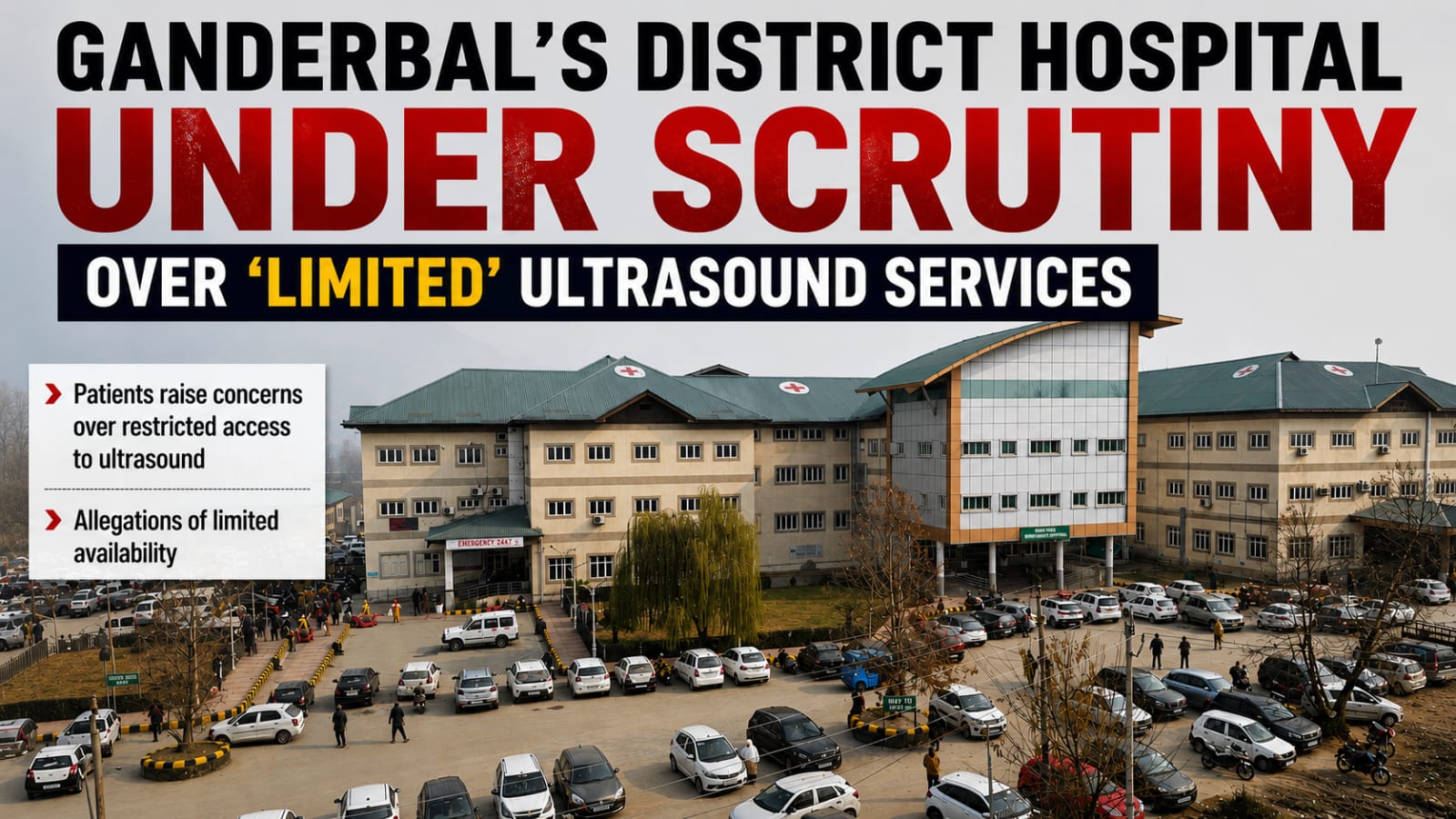
Patients allege post-8 PM unavailability forces referrals to Srinagar; hospital says 24×7 services to be rolled out soon
Aqzar Raheel
Ganderbal, May 5 : Residents of central Kashmir’s Ganderbal district have raised concerns over what they describe as “restricted and inconsistent” ultrasound services at the District Hospital, alleging that the facility effectively ceases to function after 8 PM, contrary to official claims of round-the-clock healthcare availability.
Several residents told Kashmir News Zone that patients are routinely advised to travel to tertiary care centres in Srinagar, including Sher-i-Kashmir Institute of Medical Sciences (SKIMS), Soura, and SMHS Hospital, even for routine or emergency ultrasound examinations during evening hours. They said the practice delays diagnosis and adds to the financial and emotional burden on families.
“For something as basic as an ultrasound, being referred outside the district at night defeats the purpose of having a district hospital,” a resident said.
The issue has renewed focus on the functioning of public healthcare institutions in Ganderbal, with residents pointing to a gap between official claims of improved infrastructure and patient experiences on the ground.
Locals argue that while authorities highlight investments in healthcare, the absence of essential diagnostic services beyond certain hours undermines these claims. “These assurances remain largely rhetorical unless critical services like ultrasound are made available 24×7,” another resident said.
Responding to the concerns, Medical Superintendent Ganderbal, Dr Farah, told Kashmir News Zone that the situation has been impacted by a revised deployment plan. “Earlier, doctors were deputed from Government Medical College Srinagar, but the new plan prioritises Sub-District Hospitals and Primary Health Centres, including SDH Kangan, which has affected services at our facility,” she said.
She, however, added that steps are underway to address the issue. “The hospital will soon roll out 24-hour ultrasound services, and the facility will be made fully operational without delay,” she said.
Residents, meanwhile, have called for greater accountability and timely implementation of these assurances, stressing the need for uninterrupted access to essential diagnostic services at the district level.
The situation underscores broader challenges in the region’s public health system, particularly the need to align infrastructure expansion with consistent service delivery on the ground.